
October signifies for many the start to the spooky Halloween season. But on Catalina, the tenth month of the year marks Foxtober, a time to celebrate the great comeback of the Catalina Island fox.
On a cool fall morning, the gentle lapping of waves against the shore was the only sound in an otherwise silent Avalon, as Conservancy scientists loaded into their vehicles for a day of fox monitoring. The annual fall survey has been ongoing for more than a decade after canine distemper virus nearly eviscerated the endemic fox in 1999.
Heavy rains expected from El Niño forecasted late fall into winter have moved up this year’s monitoring operations, which typically begin in October. On the Island’s west end, crews recorded 36 pups this season – that’s twice the number from last year in this area.
“In one trap, we found a father and son together,” explained Conservation Operations Biologist Becky Rudy, who this Foxtober is now in her tenth year of fox monitoring.
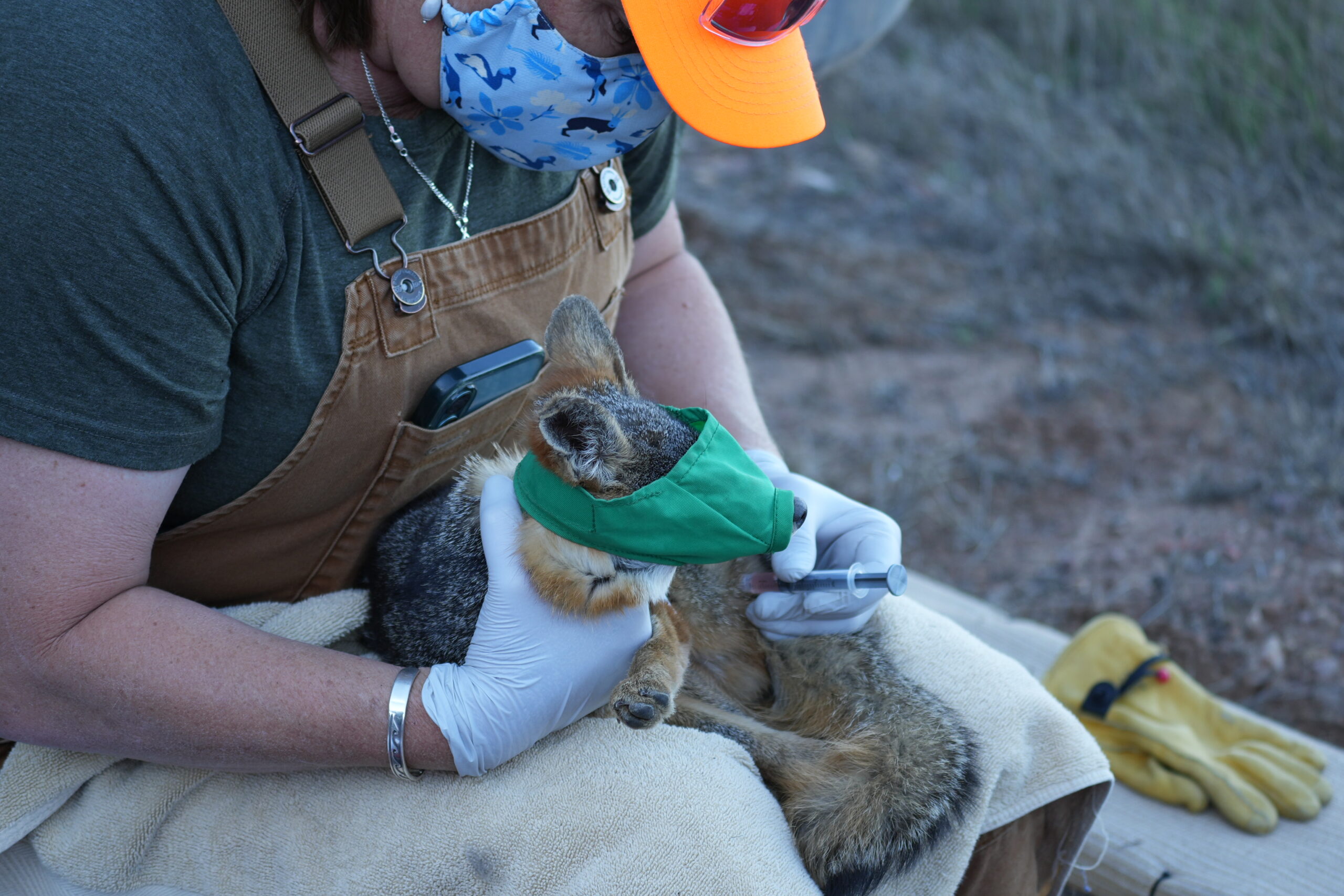
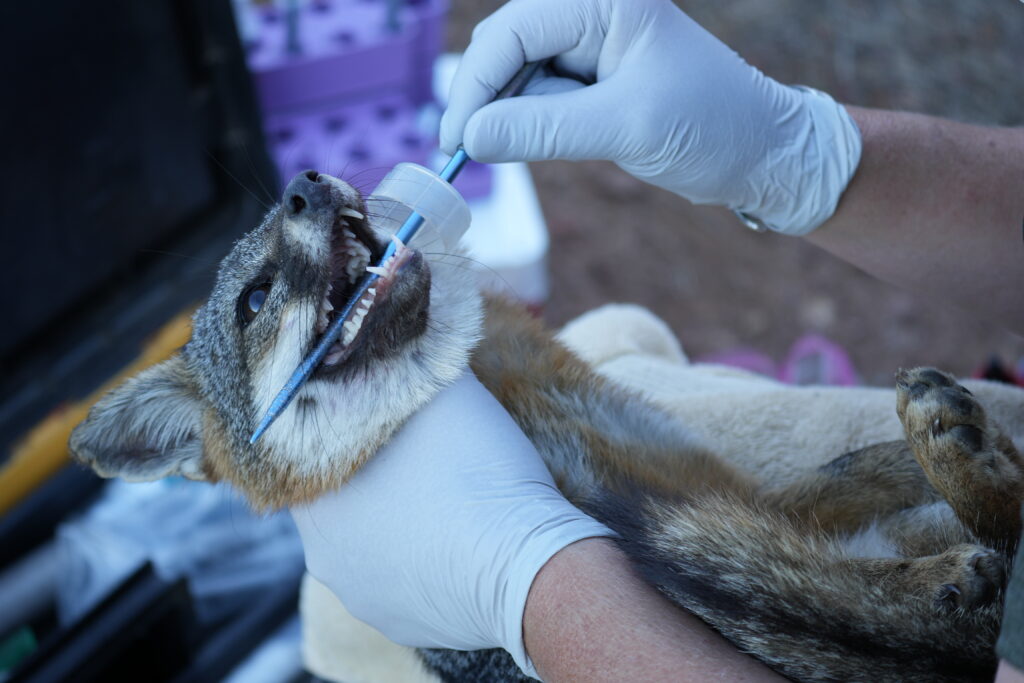
To catch the foxes, Rudy and her team bait the traps and place them across the Island. They visit each trap within 24 hours of placement to conduct their assessment, administer rabies and distemper vaccines and, if necessary, medication for ear mites, fleas and ticks, and fluids for dehydration. After just a few minutes of handling, the fox is released back into the wild.
Each fox capture is recorded by scanning a microchip in the scruff of its neck. Some foxes are fitted with a collar that allows them to be tracked through telemetry, where a radio frequency device tracks the chip and emits a beep. Telemetry is conducted by land and, thanks to support from a volunteer pilot, the air. Collared foxes are referred to as sentinel foxes because they are young and unvaccinated, making them the most vulnerable to potential disease.

“Tracking sentinel foxes is really important because disease could be reintroduced to the island and we want to be able to respond as soon as possible,” said Wildlife Biologist Destiny Saucedo. “The collars emit a frequency signal that we’re listening for with our telemetry gear. Essentially, we’re listening for beeps – if the beep gets faster, we know it’s likely a mortality signal.”
Determining a cause of death is important for understanding whether a new disease or threat is present on the Island. The signal emitted by the collar helps staff understand when a fox has died so it can be located on the landscape and collected for a necropsy.
When canine distemper broke out on the Island in 1999, it spread quickly across a majority of the fox population. Over 90% of the fox population was decimated, declining from about 1,300 animals to 100 in a single year. Quick action by scientists spared the fox. The Institute for Wildlife Studies in partnership with the Catalina Island Conservancy, launched an emergency captive breeding program, vaccinated hundreds of wild foxes, and partnered with state and federal agencies to bring the species back from the brink of extinction.
As of 2025, Catalina has an estimated 2,162 foxes. They are among one of the fastest recoveries in endangered species act history, allowing for the fox to be downgraded from endangered to threatened. This year marks the 10th anniversary of this achievement that brought people together to save this critical island creature.
Last year, scientists found that vehicle deaths were an increasing threat to the island fox on Catalina. The record shows 18 foxes were killed by vehicles. The Conservancy initiated a “Slow Down for Fox Sake” campaign to encourage Island motorists to be more mindful on roadways. Foxtober is another way to raise awareness about the fox.
The Catalina Island fox is endemic, meaning it’s only found on Catalina. In 2025, the Conservancy selected the fox as the Island ambassador and launched a naming contest. A 4-year-old Avalon boy pitched the winning name: Isla (pronounced ‘ee-sluh’). Isla is now utilized in educational programming and awareness campaigns on Catalina, as well as signage at the Wrigley Memorial & Botanic Garden.
Celebrate Foxtober from home by learning more about the fox with our documentary “Back from the Brink: Resurgence of the Catalina Island Fox.” It’s been an official selection of two recent film festivals, including the renowned Catalina Film Festival.
More Conservation
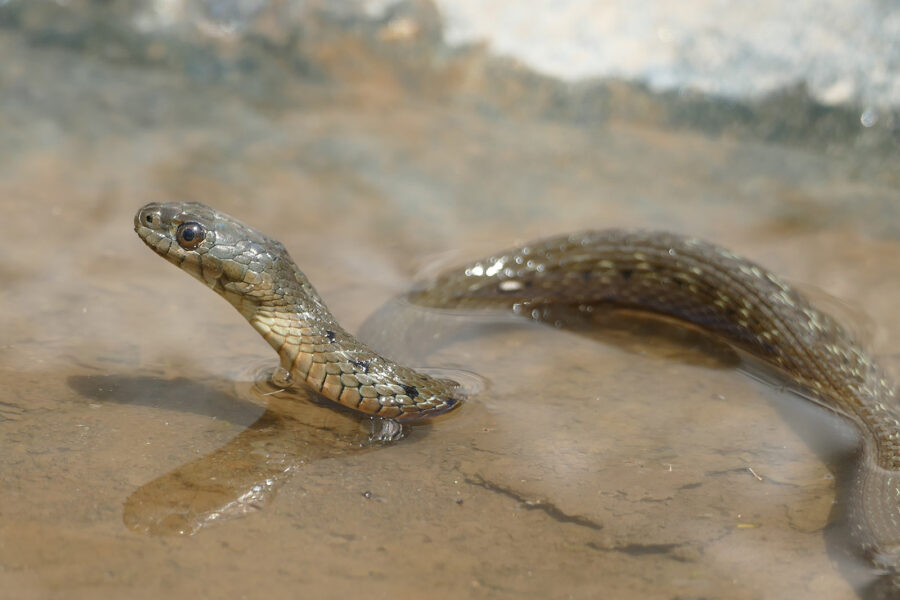
Snakes, frogs, and lizards…oh my!
ConservationOn the morning of April 5, 2022, Catalina Island Conservancy staff, American Conservation Experience interns and three Loma Linda University graduate students conducted an extensive survey spreading all the way from Ben Weston to the Airport in the Sky.
Continue Reading