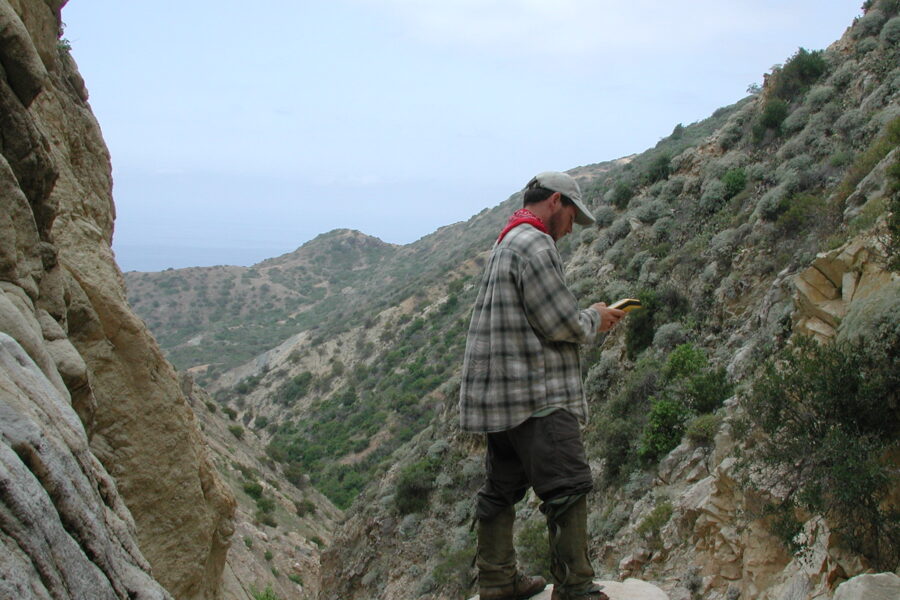
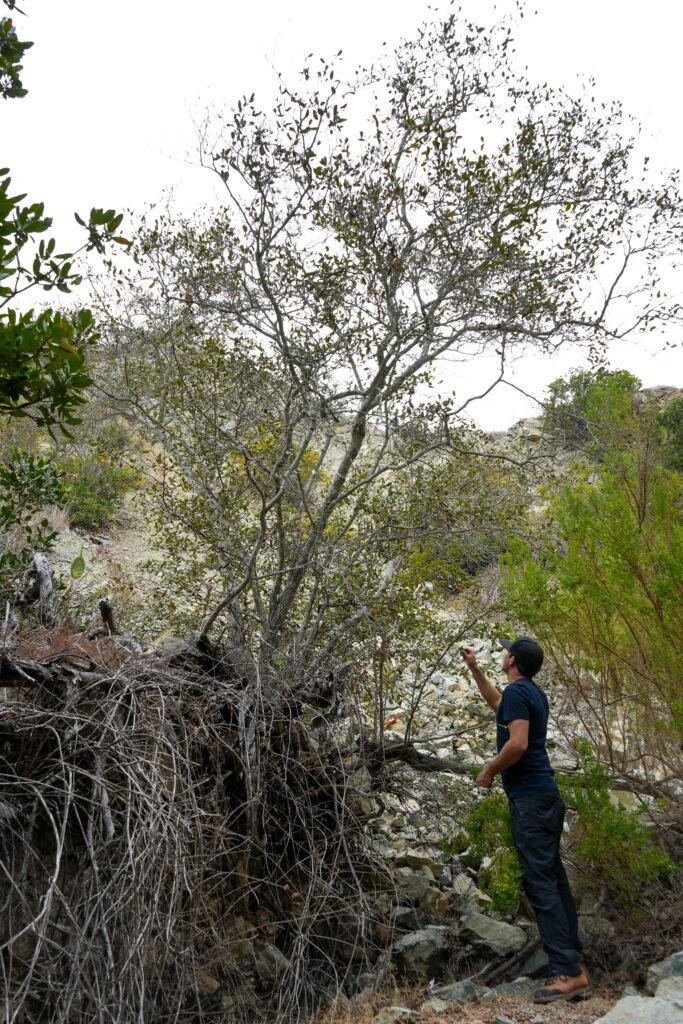
As he approached the exposed roots of a tree growing beneath a hillside of rocks in the gully of a steep canyon on Catalina Island, an expression of concern enveloped Kevin Alison’s face.
“This is Tree D and I’m very worried about Tree D,” Alison said aloud as he surveyed the Catalina Island Mountain mahogany (Cercocarpus traskiae). The ailing tree is one of just six wild specimens remaining on Catalina Island, which is the only place on Earth where it exists.
In this corridor of Wild Boar Gully, a small grove fights for survival as perilous threats loom all around it.
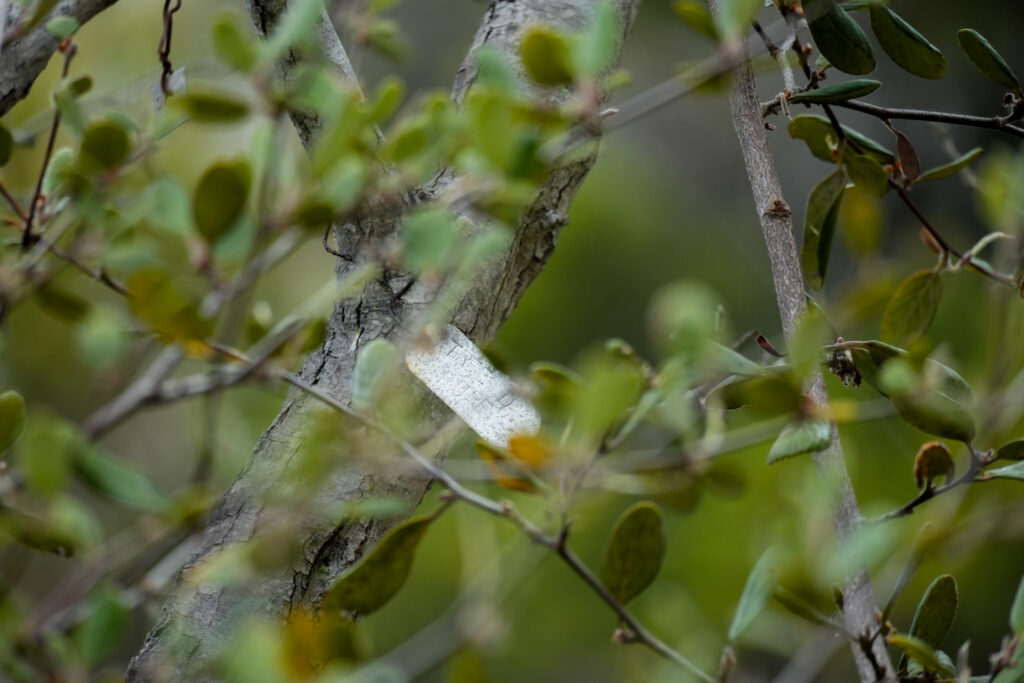
“It really shows that when it comes to conservation, there’s usually a bunch of different challenges that are in combination together that can impact a species’ survival,” said Alison, the Conservancy’s native plant manager. “So, it’s not just one thing – not just hybridization, not just the legacy of browsing or the small population size – in addition, there’s also climate change, fire risk, low biodiversity and habitats.”
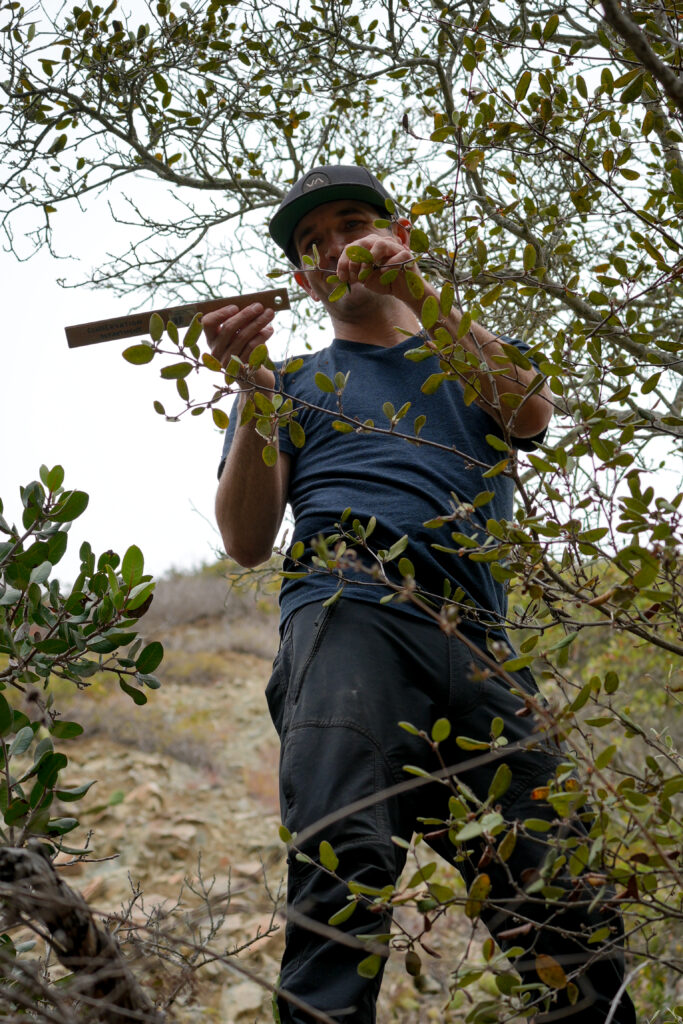
The task at hand for Alison and Lead Native Plant Technician Lexy Coons on this day of surveillance was to assess the grove for new growth, damage from pests or weather and any other changes from the previous year.
From high up in the branches, Alison took measurements and called them down to Coons, who recorded the data on a clipboard below. Their notes indicated that Tree D showed limited-to-no new growth, drought stress and overall decline in health.
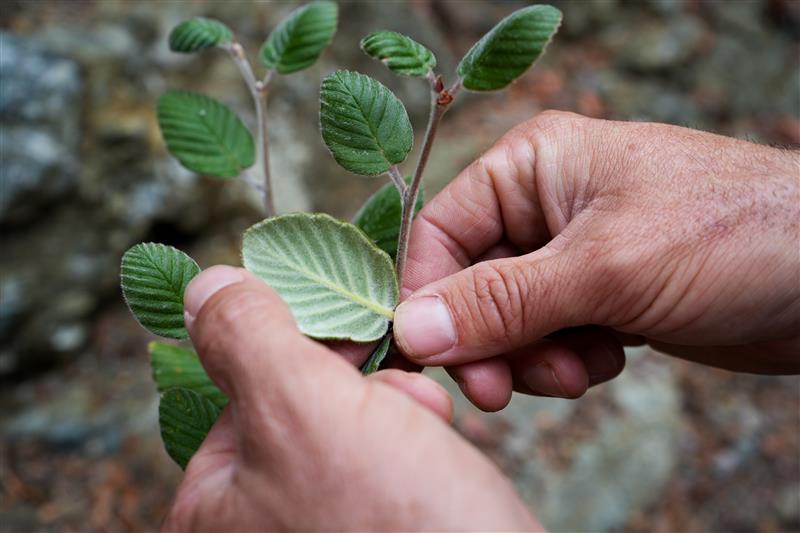
The plight of the imperiled plant can be difficult to understand. That’s because there is common mountain mahogany all over the Island and even the mainland. But as Alison explains, those plants – including the ones found at the Trailhead Visitor Center and Wrigley Memorial & Botanic Garden, are hybrids (Cercocarpus betuloides var. blancheae).
“There are thousands of them around the Island, and they also occur on other islands. But what’s so unique about what we’re here to see today is the other species, the Cercocarpus traskiae or Catalina Island endemic mountain mahogany,” he said. “They’re in the same genus – both are mountain mahogany – but they’re entirely two separate species.”

The hybridization occurs when the pollen of the dominant common species overwhelms the last six individuals of “pure” mahogany. The pure plant is overloaded with hybrid pollen, leading to virtually all new seedlings produced being hybrids. As a result, the plant is now struggling to produce pure seed. Hybridization does occur naturally with many types of plants, but the unique situation on Catalina Island – where the hybrid is outcompeting the endemic mahogany for survival – is due to the extremely low number of existing pure plants.
“When you get to such a small population size, rare plant conservation comes down to trying to save and capture and preserve all the genes in that gene pool because every gene in that population is critical to its survival and adaptability into the future,” said Alison, who has been working with the species for about seven years. “There are only six known pure individuals left and they’re very vulnerable to one big major fire and we could lose the entire species.”
But capturing those genes isn’t so simple; the two traditional methods of reproducing rare plants – seeds and cuttings – have not proven successful. The seeds are all hybrids and the cuttings, which receive root hormone, fail toproduce a new root system. This is where a new method and a lot of science comes in.
Cloning, where the full genomic sequence is captured and replicated, would allow the Conservancy to plant this exact same grove elsewhere on the Island. Alison is developing a method of cloning these plants in a lab, known as “plant tissue culture.” This may sound like a work of science fiction, but Alison learned this technique while preserving rare plants at the University of Hawaii at Hilo, where he studied natural resource management. And while this approach is novel on Catalina Island and much of the United States, Alison has already had success using a different Catalina endemic.
“We’ve been successful with our endemic Catalina ironwood (Lyonothamnus floribundus ssp. floribundus) with the cloning protocol, which has never been done before, and we’re working through the protocol right now,” he said, noting that he’s optimistic about early cloning efforts with the mahogany. “It’s going to take some science, going to take some investment in the science.”
In a small, brightly lit lab within the Conservancy’s remote office at Middle Ranch, test tubes of miniature ironwood trees and rare island cactus are growing in nutrient gel that’s been treated with bleach in a rigorous sterilization process. Even the slightest presence of microbes can lead to mold that kills off the plant. This delicate process is intensive and requires carefully monitored environmental and sanitation conditions – before, during and after cloning. But to halt the death march of North America’s loneliest tree toward extinction, drastic and creative measures are necessary.
“What I think is really showcased here in this story is we’re not putting all our eggs in one basket when it comes to our methods of conservation,” said Alison. “We’re expanding our tool belt and have all these methods involved to work in tandem together to prevent plant extinction and ensure that high biodiversity continues on Catalina Island for all species.”
The age of the trees in this grove is unknown, but they were already sizable when famed botanist Blanche Trask first wrote about them in 1897. Suffice to say these endemics bear within their branches a rich history of the Island and its wildlands. With the thoughtful intervention of conservationists, that story will continue to unfold into the next century.
—
Your donation funds work in the Conservancy’s new plant tissue culture lab, where scientists take very small parts of the Mahogany to propagate new trees in a sterile environment.