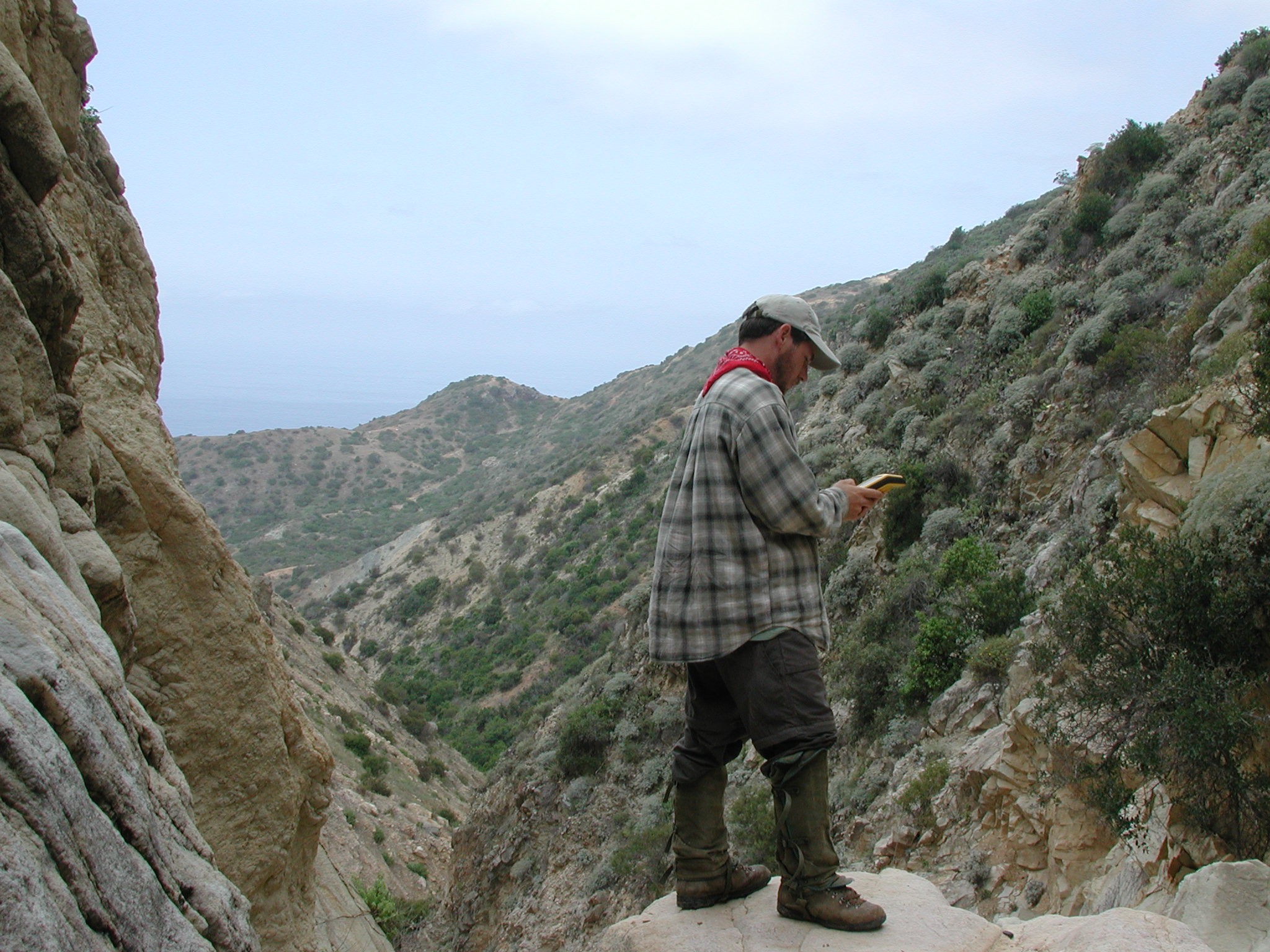
Months of trekking the Catalina Island wildlands to conduct weed mapping and eradicate invasive weeds recently earned John Knapp, a Conservancy senior conservation scientist, a prestigious honor. The California Invasive Plant Council Symposium brought conservation leaders from across the state to Ventura, where Knapp received the Jake Sigg Award for Vision and Dedicated Service.
In the early 2000s, Knapp received funding from the Conservancy to study the Island’s weed species for management, which led him to study weed science at Cal Poly, San Luis Obispo. He hiked 650 miles across Catalina Island over six months and mapped 72 different species of weeds.
“I had an old Jeep Cherokee and I’d drive to a location, hike down the ridge, then hike up the drainage,” recalled Knapp. “If I saw an infestation, I’d take a compass and range finder and GPS it. I mapped over 5,000 infestations of 72 different weed species.”
To fuel all that physical activity, Knapp said he downed cheeseburgers and milkshakes daily but still couldn’t keep on the weight.
When he later got a job as an invasive plant program manager with the Conservancy in 2004, he used his findings to prioritize the invasive plant removal plan. Knapp spent years working to eradicate weeds that were threatening different plant communities on Catalina Island.
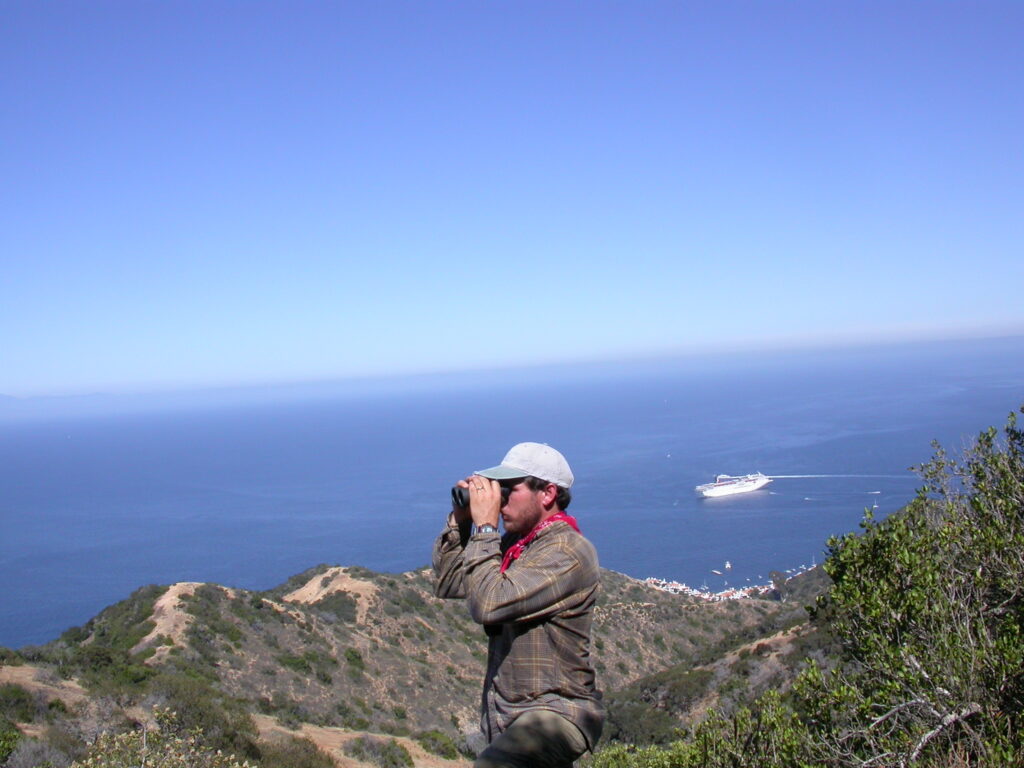
He left the Conservancy in 2008 to start his own company and did work across California and the Channel Islands, mapping weeds and treating them for six years.
“Weed mapping changed over time with technology. To collect info about species infestation, we used to do a point and line features,” he said, describing a method that involves using a measuring stick and recording each species found along that line. “Now, a virtual grid is applied. You enter data about how dense the population is, the size of the infestation, its phenology – flowers or fruits – to understand the seed bank.”
Through his private practice, Knapp and his crew took to the skies to eliminate weeds across other Channel Islands.
“We’d use helicopters to detect the weeds and access infestations, which helped us outpace reproduction,” he said of their operation. “By mapping on the ground, we could reach every plant, but we couldn’t outpace the reproduction. The helicopter reduced access time and allowed us to do that at half the cost.”
As a leader in weed mapping methodology, Knapp learned a lot about how weeds behave, spread and respond to treatment. “It’s very interesting to see how they invade water resources, which are very critical for people and wildlife,” he said. “Some plants will cause sediment to build up and cause streams to disappear because of the sediment. The pores (stomata) in their leaves that are always open, constantly sucking up water. Knowing the distribution and what species like water, you can see what species invade that resource.”
This is especially important in an area like Catalina Island’s Cottonwood Canyon, for example, which is highly diverse with various species of animals and plants. “If you had a bunch of weeds threatening those resources, you need to do something about it,” he said.
Knapp’s work has propelled the field of invasive plant management forward, informing countless other biologists on how to create a weed census. With his return to the Conservancy in August 2025, he’s using his expertise to conserve native plants in a place he’s passionate about protecting. That work earned him the Jake Sigg Award, a well-known and respected native plant advocate whose award was actually created with Knapp’s help about 20 years ago.
“[Sigg] was doing great work – I was a volunteer at the time. We engraved a machete as the award,” said Knapp. “I was really surprised to receive it. I always thought of this award as the old timer’s honor for conservationists who’ve been in this field for a long time. I have, but I know I have a lot more work left in me.”
And that’s a good thing because removing invasive plants is an endless job that requires innovative approaches to protect native species and the natural landscape.