
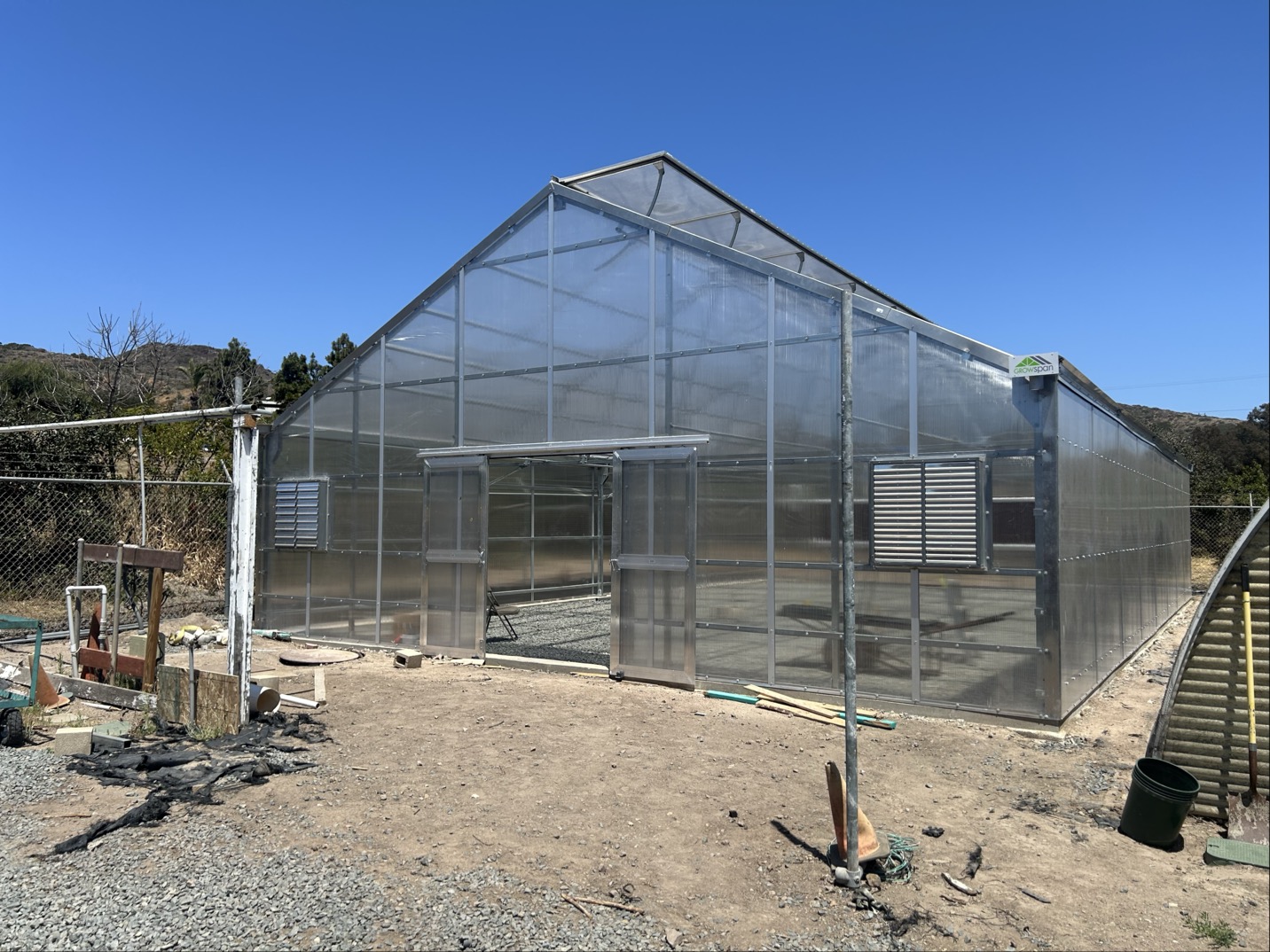
A new greenhouse at the Ackerman Native Plant Nursery will help acclimate native and rare plants as Conservancy staff transition them to the conditions of Catalina Island’s wildlands. This state-of-the-art greenhouse is the biggest improvement to the facility at the Ackerman Native Plant Nursery since it was built in 1999.
Construction of the 1,440 square foot structure took place this spring over the course of 13 days. It replaces a simple shade house structure that the native plants team affectionately called “Baby House,” because it’s where seedlings got their start. The greenhouse can hold up to 8,000 small plants but will likely house between 2-4,000 at a time.
“We’re using it to start baby plants but it’s essential for doing tissue culture on plants like our rare Catalina Island mahogany and ironwoods,” said Native Plants Manager Kevin Alison. “Conditions won’t get too cold, too hot or too dry and it’s protected from elements like wind. We do get near frost in Middle Canyon. It doesn’t stay long but it can harm baby plants.”
Inside the greenhouse, an evaporative cooler regulates internal temperature and humidity. And a convertible roof opens and closes in response to temperature shifts.
The evaporative cooler, also known as a swamp cooler, acts as a low-tech air conditioner. Water is fed into the system and drips down the corrugated wall. Air is pulled into it by exhaust fans and as air goes through with dripping water, evaporation occurs and creates a cool down, as well as increased humidity. If it gets too hot, a motor will automatically open sections in the roof for heat to escape.
Outside the new greenhouse, a precipitation garden uses plants to stabilize, utilize and clean the water as it percolates and moves through the nursery. The water drips down to the garden below, watering thirsty plants like the scarlet monkey flower and stream orchid, native plants on Catalina. The greenhouse will also assist in some fog capture, which feeds into the precipitation garden, according to Alison.
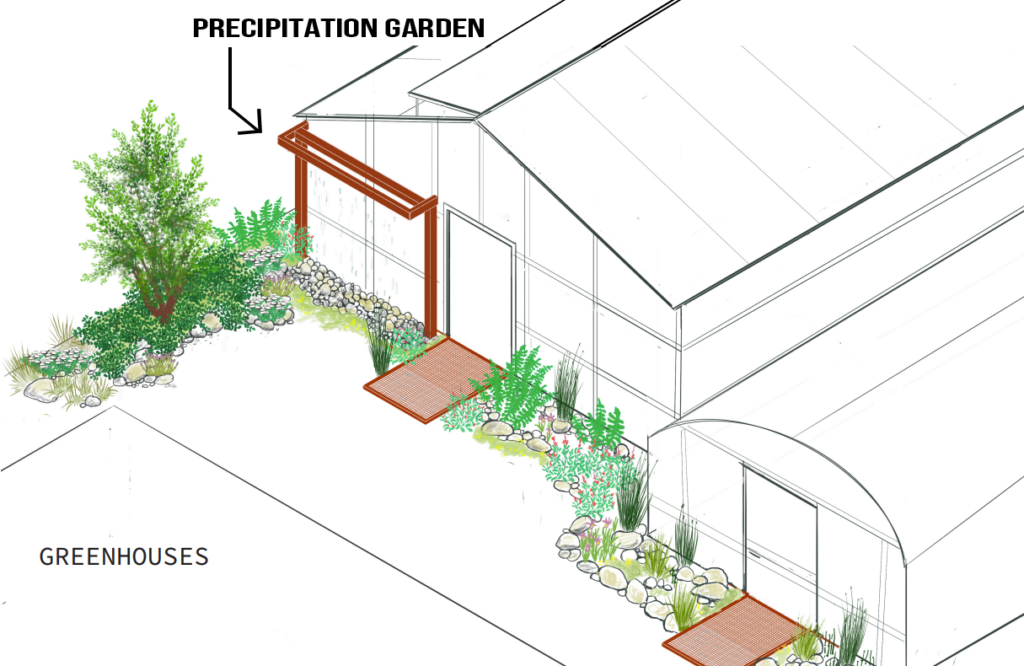
The precipitation garden, fog harvest and bioswales (a naturally engineered drainage that mimics a creek or stream), are all emulating the natural hydrologic cycle on Catalina, and useful as an educational tool as much as a conservation garden. These features help create a more closely controlled environment for delicate young plants.
“Plants coming from the lab are really sensitive,” said Alison. “They don’t have that thicker waxy cuticle layer with strong stems and leaves. Too much sun, wind and moisture could kill off the plants. They need to be acclimatized or hardened off, which slowly transitions them to a more natural setting.”
The Catalina Island mountain mahogany (Cercocarpus traskiae) and Catalina ironwood (Lyonothamnus floribundus subsp. floribundus) are endemic, meaning they’re only found on Catalina Island. Only six pure mahogany are known to exist and just under 150 ironwood groves remain. Alison and his team have been trying various approaches like cloning (making a genetic copy of a plant by growing a new plant from its cells or tissue), hydroponics (a method of growing plants using a water-based mineral nutrient solution instead of soil), air layering (a propagation technique that encourages a branch to grow roots while still attached to the parent plant )and other innovative strategies to prevent both species from dying out.
“The seeds and the baby plants are hope,” explained Alison. “It’s hope for the future and our efforts to build and set this environment up for success. It is an investment in that future and the future of Catalina. We can take action to protect this Island. This is a major tool to prevent extinction.”
By having this new structure, the Conservancy can collect seeds and replicate different ecosystems around the Island. It’s a tool, Alison said, in helping restore native and endemic species on Catalina as part of Operation Protect Catalina Island.