
Reducing wildfire risk and intensity is a key element of the Conservancy’s Operation Protect Catalina Island. That work will now be better supported by significant funding awarded in May by the San Gabriel and Lower Los Angeles Rivers and Mountains Conservancy (RMC) Board.
Roughly $2.3 million in funds will support fire prevention efforts like invasive plant management and brush clearing. It will also support workforce development.
“The addition of Catalina Island as an area of funding for the RMC has created this opportunity to support even greater wildfire resilience and ecological stewardship in partnership with organizations like Catalina Island Conservancy,” said Mark Stanley, Executive Officer San Gabriel and Lower Los Angeles Rivers and Mountains Conservancy.
Fire Risk
Catalina is designated as a Very High Fire Hazard Severity Zone by CAL FIRE and has limited access to mainland disaster resources. About 350,000 visitors access Conservancy lands annually, alongside 4,000 island residents. Evacuation options are limited. The 2007 Island Fire broke out on the hillsides above Avalon and devastated 4,750 acres (about 10% of the Island). The human-caused blaze was driven by wind and fueled by extremely dry vegetation.
A 2026 wildfire on a neighboring Channel Island devastated about 29 square miles (35% of the island), charring the landscape and impacting wildlife. The human-caused blaze ignited in May and burned nearly three weeks. For Stanley, this disaster highlights the value of invasive plant management.
“The recent wildfire on Santa Rosa Island underscores the importance of proactive investment in wildfire resilience across California’s island ecosystems. This project represents a critical step toward protecting Catalina Island’s unique and sensitive ecosystems through long-term, climate-adaptive stewardship.”
Invasive Plants
This project is shaped by landscape conditions on Catalina Island, where native vegetation has converted to highly flammable invasive grasses. Those grasses now dominate 35% of ecosystems. Fennel, Harding grass, mustard and Flax-leaf broom are among the most flammable. These plants increase fire frequency, negatively impact native species and result in documented biodiversity loss.
“We are deeply grateful for the Rivers and Mountains Conservancy’s ongoing support of our efforts to control invasive plant species on the Island,” said Senior Director of Conservation Lauren Dennhardt. “Doing this work across such a large area, often in rugged terrain, takes dedicated hands, resources and expertise. With their generous support, we can complete more critical conservation work to preserve our Island ecosystems.”
Project Plan
Over the next two years, the funding will support work that reduces wildfire risk and intensity through removing flammable, invasive plants. The Conservancy will also create wildfire buffers and stabilize soil to support native plant growth. Surveys of flammable invasive grasses and plants will be used to inform future work.
Crews will treat invasive plants across 10 acres around Shark Harbor and Cottonwood Canyon. They will focus on the plants within the 10-acre restoration testing site near Airport in the Sky, as well. The grant supports invasive plant surveys across 1,000 acres in eight priority watersheds including Shark Harbor, Cottonwood Canyon, Coffeepot Canyon, Grand Canyon, Silver Canyon, Rattlesnake Canyon, Hamilton Cove and Avalon Canyon.
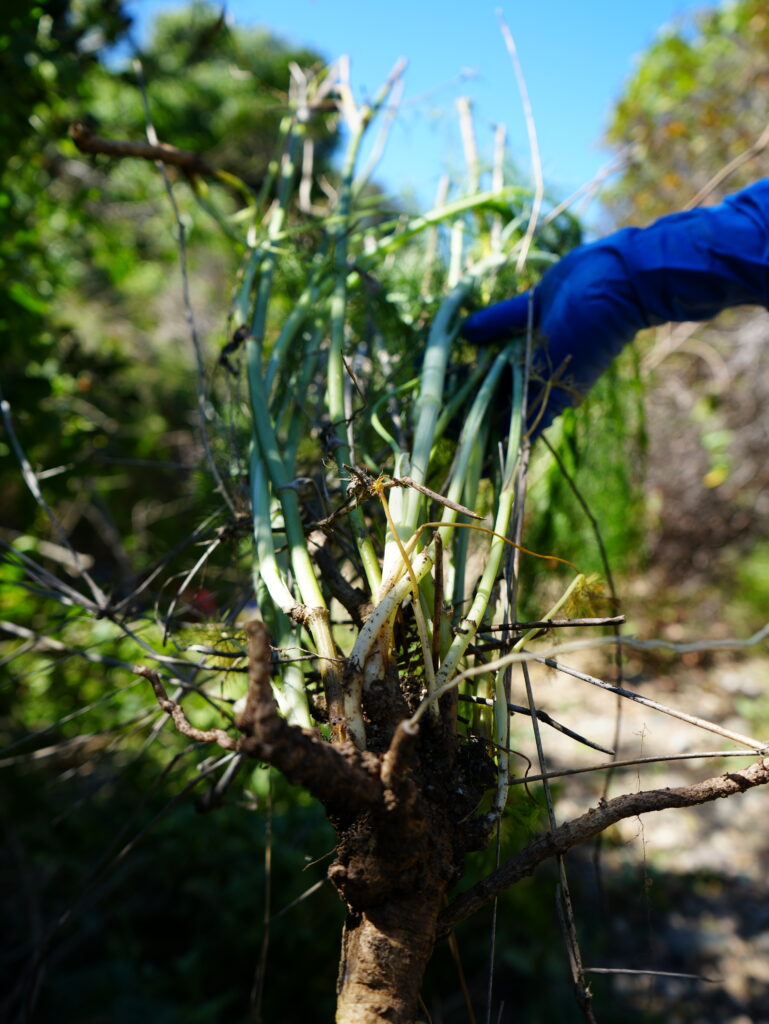
Removal of invasive plants will be accomplished through hand-pulling and cutting, careful and selective treatments, and using mapping software to track progress and effectiveness. The results will guide future treatment applications on invasive plants and will help inform how invasive plant infestations are managed over time.
Crews will also clear and maintain wildfire buffers for 26.25 miles across six trail and road segments (Airport Rd. to Blackjack Campsite, Middle Ranch Rd., Airport to Little Harbor via Trans-Catalina Trail, Blackjack to Airport in the Sky via Trans-Catalina Trail, and Airport Rd., and some other smaller segments).
This work will advance Operation Protect Catalina Island and will focus on restoring rare island ecosystems that are naturally more resilient to wildfire and climate stress. It will also provide 64 weeks of workforce development opportunities for corpsmembers through Conservation Corps of Long Beach.