
It’s not the typical love story, but on Catalina Island, a Valentine’s Day romance is unfolding. Despite being cold blooded, the male side-blotched lizards pursues their mates in one of three distinct ways, depending on chin color.
“Males with blue chins are monogamous – they mate with one female and protect that one female,” says Cole Ivie, a graduate student at Cal Poly, San Luis Obispo. “Orange chins have multiple females and try to protect all those females the best they can. Yellow chins are sneaker males, so they sneak in and try to mate with another male’s female.”
Researchers describe the mating strategies of the side-blotch lizard (Uta stansburiana elegans) as an evolutionary game.
“When all three color morphs are present, it’s sort of a rock, paper, scissors game. One color always does better than another color,” says Lauren Chan, a Cal Poly associate professor. The theory developed in 1996 by Dr. Barry Sinervo and Dr. Curtis Lively shows blue (faithful) beats yellow, orange (aggressive) beats blue, and yellow (sneaky) beats orange.
Lizards’ reproductive behavior is one point of interest, but these researchers from Cal Poly teamed up with Conservancy scientists to find out how and when the lizards arrived on Catalina Island.
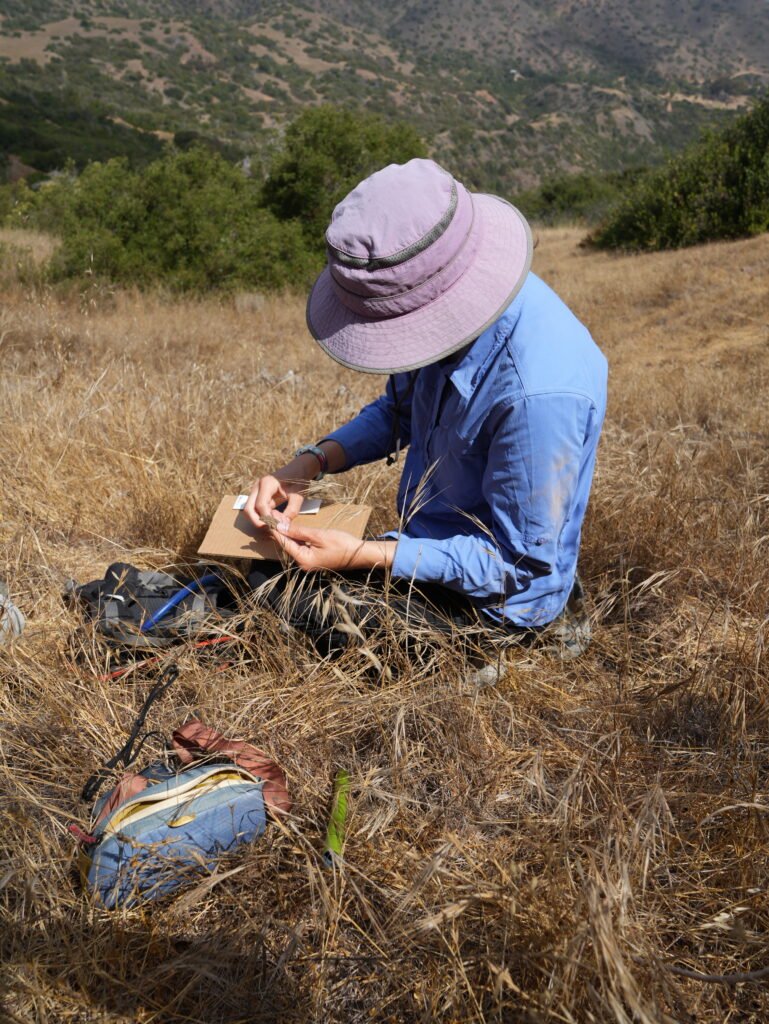
“They have different colonization histories between the islands. Catalina is really big and has always been separated from the mainland, which is unique,” said Zoe Johnson, a master’s student at Cal Poly, San Luis Obispo. “They somehow got out here, and we’re trying to figure out what they’re doing.”
Along with Catalina Island, this species of lizard is found on both Anacapa and Santa Cruz Islands, as well as San Clemente. Although it is a common and widespread species on the mainland, it plays its own unique role on the islandecosystems, controlling insect populations and serving as food to Island birds and larger reptiles.
Conservancy staff guided the researchers to hot, elevated places where the lizards were likely to be.
“They love chaparral and super sandy substrate, they love having a bush where they can run and hide, and a rock connected to the bush where they can bask on and get heat from,” said Ivie. “They are ectotherms so they need heat from the environment, typically out in the middle of the day when it’s hottest.”
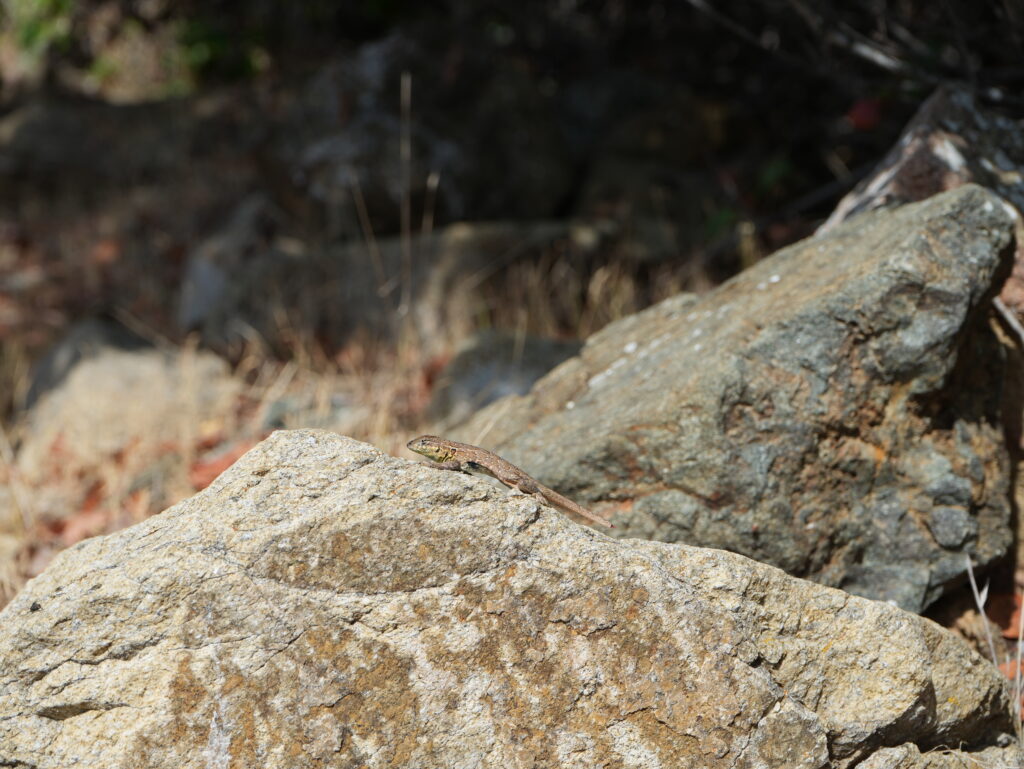
The researchers turned over rocks and stumps, peering through tall grass until, like cupid’s arrow, they snared these reptile Romeos.
“We use lassos to do that, basically a fishing pole with a string on the end of it and like a slipknot on the end,” said Ivie. “Slip it around the lizard’s head, pull back toward the base of the tail very gently, pick it up and you have a lizard on a line.”
Because the lizards are so light weight – approximately 3 grams – there’s not enough tension on the lasso to pull it taught. The lizard isn’t harmed and is simply held in place while researchers conduct their assessments.
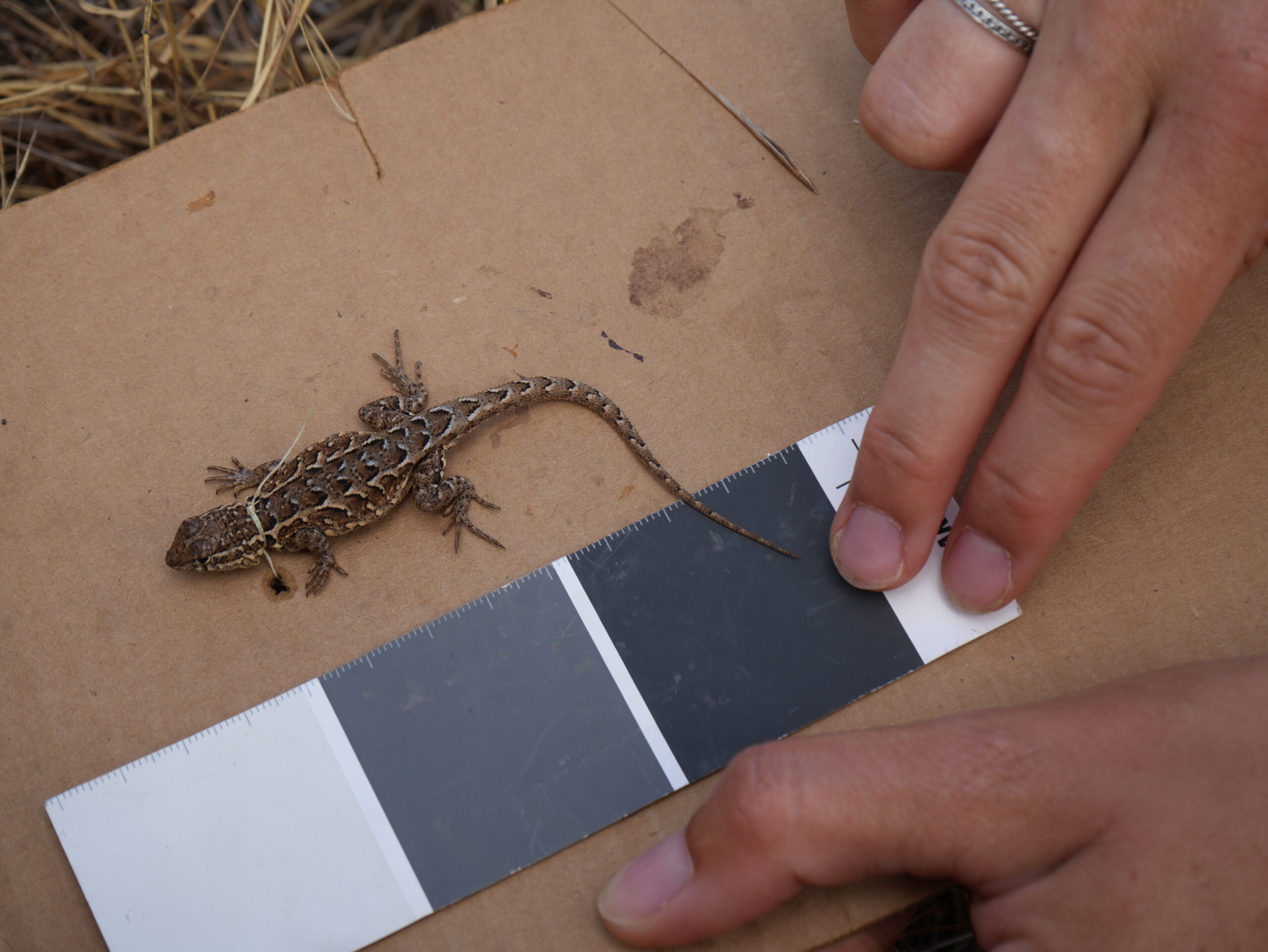
They measure its length “snout to vent,” and weight. They record its color and pattern, which is brown, gray, yellowish or black, with dark blotches, spots and sometimes stripes. The lizard’s sex is recorded then a piece of tail is taken as a sample for genomic sequencing.
“They have adaptations for the tail to be able to break in a specific spot,” says Lauren. “So we pinch and pull of a little bit of tail and that allows the tail to grow back for the lizard.”
The tail breaks free when the lizard is caught by a predator. As a defense mechanism, the segment continues to move, distracting its would-be captor as the lizard gets away.
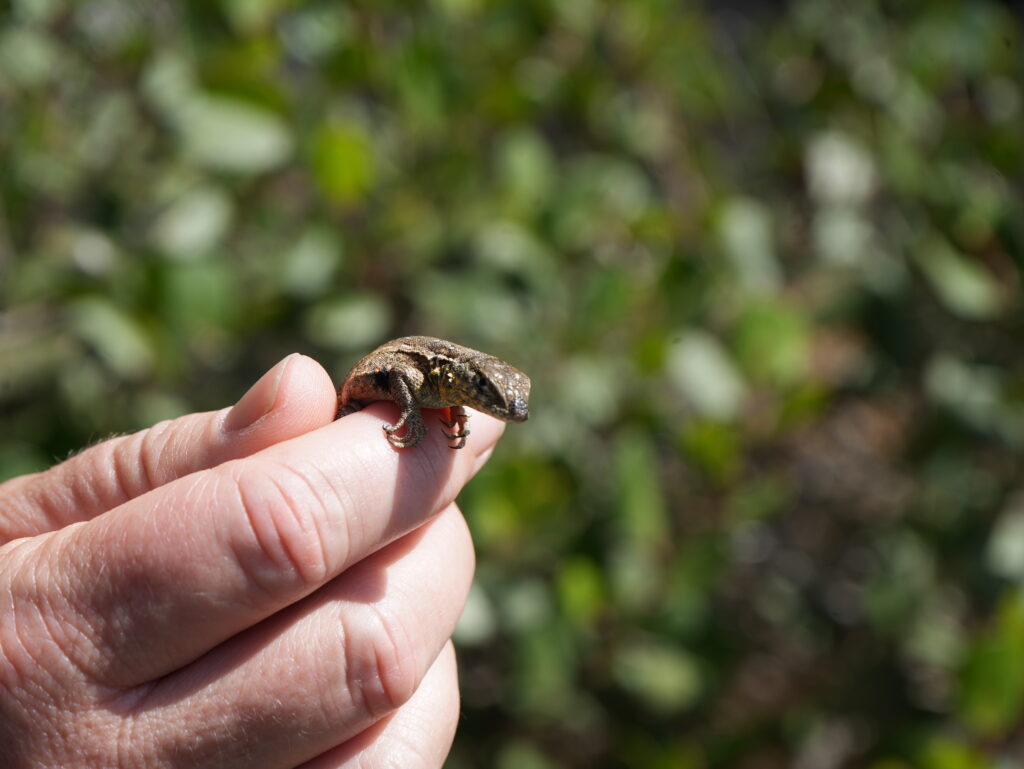
The samples collected here will be compared against lizards on other Channel Islands to determine a possible lineage.
“If I can line up when lizards got to each island with human events, maybe we can know if humans moved lizards to the islands,” said Ivie. “Maybe that’s the Tongva, or the Chumash on the Northern Islands, or the Navy or all the movement we’re doing today.”
We may never know if they live happily ever after, but we could soon know more about how and when these lizards arrived on Catalina Island.